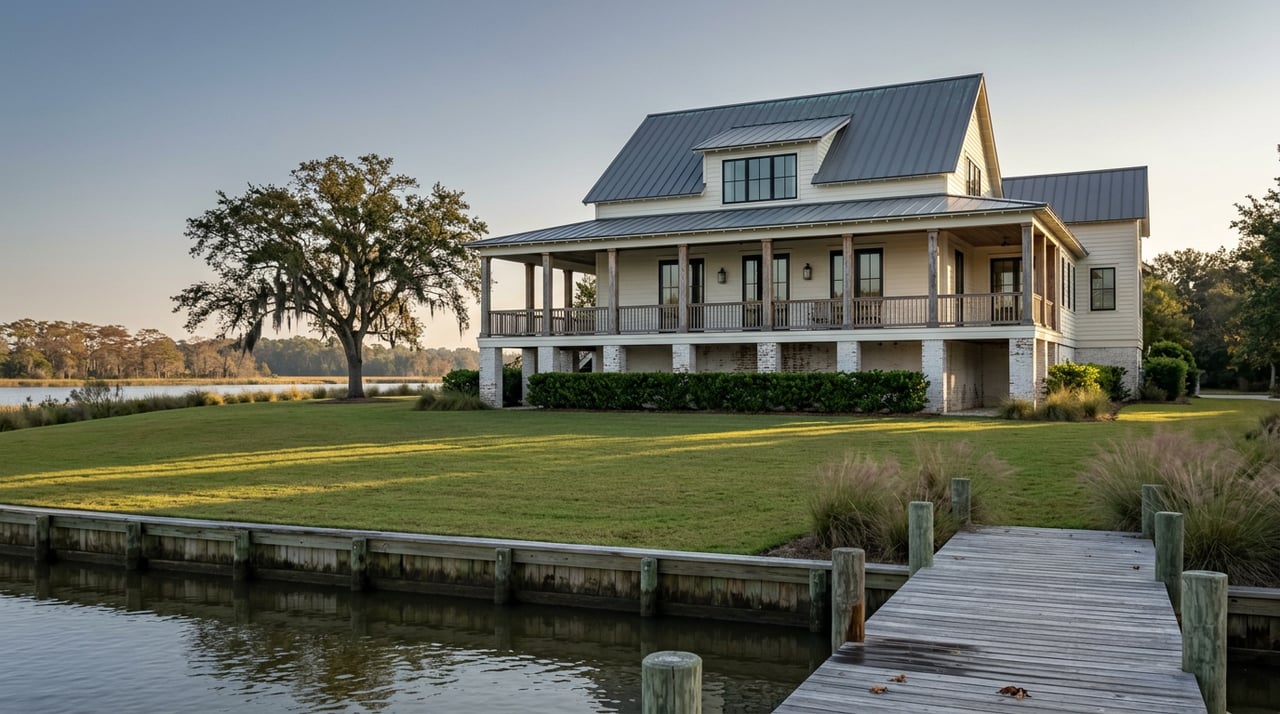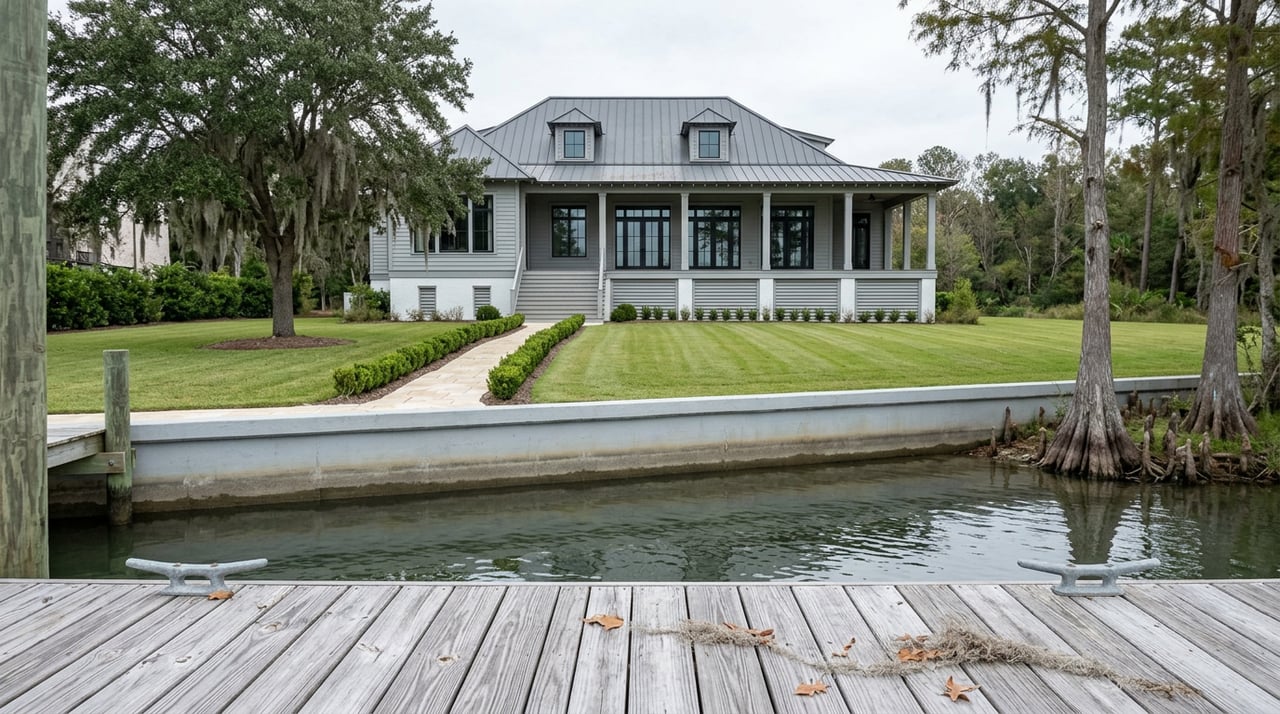
Two listings go up in Madisonville this month, both tagged "waterfront," both priced within a few thousand dollars of each other. One is a three-story townhome behind a gate, with an assigned boat slip and an HOA that handles the marina. The other is a cottage on a long, narrow lot in the historic downtown grid, with a concrete bulkhead nobody can confirm was ever permitted. A buyer scrolling by price alone would treat these as the same purchase. They are not.
That gap matters more than usual right now. Madisonville's waterfront segment is thin. As of early September 2026, roughly 33 waterfront homes are on the market townwide, and only one closed in the trailing month. A market that small does not behave like a normal comp sheet. One high-end sale or one distressed dock can swing the median without telling you anything about the property you're actually considering. Townwide, the broader market looked calmer: the median list price in September 2026 sat near $455,000, with homes spending a median of 78 days on market, down from a year earlier. Waterfront listings ran higher, with a median near $486,000, but that number was built on so few transactions that it barely counts as a trend. It's a snapshot of whatever happened to be for sale.
So the price tag tells you less than the address does. What actually separates one Madisonville waterfront property from another is which of three distinct products it belongs to, and each one carries its own permitting history, insurance exposure, and maintenance obligation that a listing photo will never show you.
Three products, one word
The historic downtown grid holds the oldest waterfront stock: cottages and updated homes on long, narrow lots that run straight from the street to the river, the layout dating back to when Madisonville's identity was built on boatbuilding. These downtown river lots are where you'll find older bulkheads, private boat launches, and docks that may or may not have a permit on file anywhere.
A second category sits inland from the main downtown waterfront, in gated developments built around interior canals, lakes, or creeks. Bedico Creek Preserve is the clearest example: a 500-plus acre conservation community with its own bike paths, fishing pier, and pools, where lots and lot-adjacent water access come with HOA dues of roughly $1,050 a year plus a one-time $1,050 transfer fee at closing. The tradeoff here is the same in every gated, planned community built around a shared launch or interior canal rather than a private dock off your own backyard: you get amenities and management, but you also get an HOA with its own rules about docks, boat size, and slip use.
The third category is marina-style ownership, mostly townhomes and condos in communities like Tchefuncte Harbour, where the water access comes as an assigned slip inside a gated pool-and-clubhouse community rather than a bulkhead you own outright. A few minutes downriver, Marina del Ray, the only marina below the Madisonville Bridge, just finished installing a new stretch of floating wet slips at its "D" dock, a reminder that even the marina infrastructure around this town keeps shifting.
| Product type | Example communities | What you actually own | Main risk |
|---|---|---|---|
| Historic downtown river lots | Downtown Madisonville's older river blocks | A private dock and bulkhead on a narrow, deep lot | Unverified or aging permits |
| Gated interior-canal developments | Bedico Creek Preserve | Shared amenities plus lot-level or community water access | HOA dues and shared-infrastructure rules |
| Marina-style condo and townhome communities | Tchefuncte Harbour | An assigned slip inside an HOA-run marina | Slip agreements and shared maintenance costs |
Buyers comparing across these three categories are not comparing degrees of the same thing. They're comparing different legal and financial arrangements that happen to share a word on the listing sheet.
The permitting layer no photo shows
Any work on a dock, bulkhead, or shoreline in this market runs through three separate approval processes: St. Tammany Parish, Louisiana's coastal-use program, and the U.S. Army Corps of Engineers. That's true whether you're replacing a rotted piling or adding ten feet of new bulkhead. The parish's own zoning code draws a hard line even for simple repairs: when you replace an existing bulkhead, the new one has to run parallel to the old one and can't extend more than one additional foot into the waterway, or the project gets reclassified and has to meet the full land-reclamation permitting standard instead of a routine repair.
That distinction is not academic for older downtown lots, where decades of small repairs may already be pushing against that one-foot line without anyone tracking it.
There's a sharper version of this friction if you're looking near the Tchefuncte corridor's gated golf communities. Louisiana lawmakers passed a five-year moratorium in 2025, now codified as Act 115, that blocks the state and parish from issuing any new Class B bulkhead-construction permits within a specific mapped area of St. Tammany Parish through January 1, 2030. The restriction names two water bodies directly: Lake Emfred and Suter Slip, both part of the private lake system inside the Tchefuncta Country Club community along the same river corridor buyers already touring Madisonville tend to cross-shop. If a property you're considering sits inside that boundary and needs new bulkhead work, the answer for the next several years is no, regardless of what a contractor quotes you.
None of this shows up in a listing description. It shows up when you ask for permit records, and if the seller can't produce them, you're the one who inherits the question.
The insurance line that never matches the label
Flood exposure is the other place "waterfront" hides real variation. Some lots in this market are marketed specifically as Flood Zone C, the lowest-risk classification, where flood insurance isn't required by a mortgage lender. A 1.3-acre lot in Black River Estates, for instance, was listed with that flood zone called out as a selling point. Other waterfront parcels closer to the river or lake sit in Zone AE, where a federally backed mortgage will require flood coverage as a condition of closing, and premiums are priced against a base flood elevation that has to be verified with an elevation certificate.
Two homes can carry the word "waterfront," sit a few blocks apart, and require completely different insurance commitments for the life of the loan. The only way to know which one you're looking at is to pull the FEMA Flood Insurance Rate Map for the specific parcel, not the neighborhood, and to ask for an elevation certificate before you're deep into a contract. St. Tammany Parish's own permitting office fields flood-zone questions directly, and it's worth a call before you write an offer, not after an inspection turns something up.
A few questions worth asking before you tour
Does a Flood Zone C label mean I'll never need flood insurance? It means your lender likely won't require it today. FEMA updates flood maps periodically, and a future remapping can move a property into a higher-risk zone. Treat the current zone as accurate for now, not permanent.
If a bulkhead on a property I'm buying was never permitted, who fixes that? Typically the buyer, once you own it. Unpermitted work can complicate future repairs or a future sale, since a new project may require retroactive approval before parish, state, or Corps sign-off on anything new.
Does the Lake Emfred bulkhead moratorium affect docks too, not just bulkheads? The 2025 moratorium is specific to Class B permits, which cover bulkhead construction. Dock and pier work fall under separate permit classes, so confirm with the parish permitting office which category your planned project falls into before assuming the restriction does or doesn't apply.
A waterfront address in Madisonville can mean a private dock you maintain yourself, a marina slip an HOA manages for you, or a shared launch a subdivision runs collectively. Each comes with a different permitting history and a different insurance bill, and none of that separates itself out in a listing price. If you're comparing waterfront options in this market, the property type matters as much as the number attached to it.
If you want a second set of eyes on what a specific waterfront listing actually includes, permits and all, Gina Constantino has spent years working this exact stretch of the Tchefuncte and can help you sort out which of these three purchases you're really looking at. Let's Connect.